
Stress Fractures: Symptoms, Causes and Safe Recovery

A stress fracture is a small crack or area of bone damage caused by repeated loading, often from running, jumping, dancing or a sudden increase in training. It usually causes localised pain that gets worse with activity and settles with rest.
Early recognition matters. Many stress fractures recover well with modified activity and a gradual return to loading, but some sites need more cautious management because they have a higher risk of delayed healing or a complete fracture.
As a Chartered Physiotherapist in Colchester, I help people assess possible stress fractures, modify loading safely and progress rehabilitation towards a confident return to running, dance or sport. My experience includes supporting athletes in professional football, rugby and The Royal Ballet.
If walking is painful, you are limping or symptoms are worsening, read the assessment advice below before continuing to train, or explore sports injury physiotherapy in Colchester.
What does a stress fracture feel like?
A stress fracture often starts gradually rather than after one clear injury. Common signs include:
Localised pain in one specific area of a bone.
Pain that increases during running, jumping, walking or other weight-bearing activity.
Pain that improves with rest but returns when activity resumes.
Tenderness when pressing on one particular spot.
Pain that may progress to pain during everyday walking, at rest or at night if training continues.
In some cases, swelling or discomfort around the painful area.
Runners often notice pain that begins towards the end of a run, then starts earlier in subsequent runs. Dancers and jumping athletes may notice pain after repeated take-offs and landings.
A stress fracture is part of a wider group of injuries called bone stress injuries. This ranges from an early stress reaction, where the bone is irritated and overloaded, to a stress fracture, where a clearer structural crack has developed.

What causes a stress fracture?
Bone constantly adapts to the loads placed through it. When loading is manageable and recovery is adequate, bone can repair and become stronger over time.
A stress fracture can develop when repeated loading exceeds the bone’s ability to adapt. This may happen because of:
A rapid increase in running distance, frequency, intensity or jumping volume.
Returning to sport too quickly after time away.
Insufficient recovery between hard training sessions.
Changes in training surface, footwear or technique.
Reduced strength, balance or control around the hip, knee, ankle and foot.
Previous injury or a period of reduced activity.
It is rarely just “too much running.” The important question is whether the recent training load, recovery, strength and overall health have given the bone enough capacity to tolerate the activity.
Bone health, nutrition and REDs
Bone health is influenced by more than training load. Nutrition, hormones, sleep, stress and overall energy availability all play a role.
The term Relative Energy Deficiency in Sport (REDs) describes the range of health and performance problems that can occur when energy intake does not adequately support training and everyday bodily functions. It can affect athletes of any gender and is relevant to recreational runners as well as elite athletes.
Signs that may warrant further assessment include:
Repeated or recurrent stress fractures.
Ongoing fatigue or poor recovery from training.
Unintentional weight loss or restrictive eating patterns.
Changes in menstrual function in women.
Low libido, fatigue or other hormonal symptoms in men.
Frequent illness, poor sleep or a marked drop in performance.
Calcium and vitamin D are important for normal bone health. If someone has recurrent bone stress injuries, low energy availability, or other relevant health factors, a clinician may consider whether nutritional assessment, blood testing or input from a sports doctor is appropriate. This should be individualised rather than treated as a routine solution for every stress fracture.
High-risk and low-risk stress fractures
Not all stress fractures are managed in the same way. Clinicians often group them into low-risk and high-risk sites.
Type | What it means | General approach |
Low-risk stress fracture | Usually in an area with a good blood supply and a lower risk of delayed healing. | Often managed with activity modification, symptom-guided loading and a gradual return to sport. |
High-risk stress fracture | Located in an area with poorer healing potential or higher forces through the bone. | Usually needs earlier assessment, closer monitoring and sometimes protected weight-bearing, immobilisation or surgical opinion. |
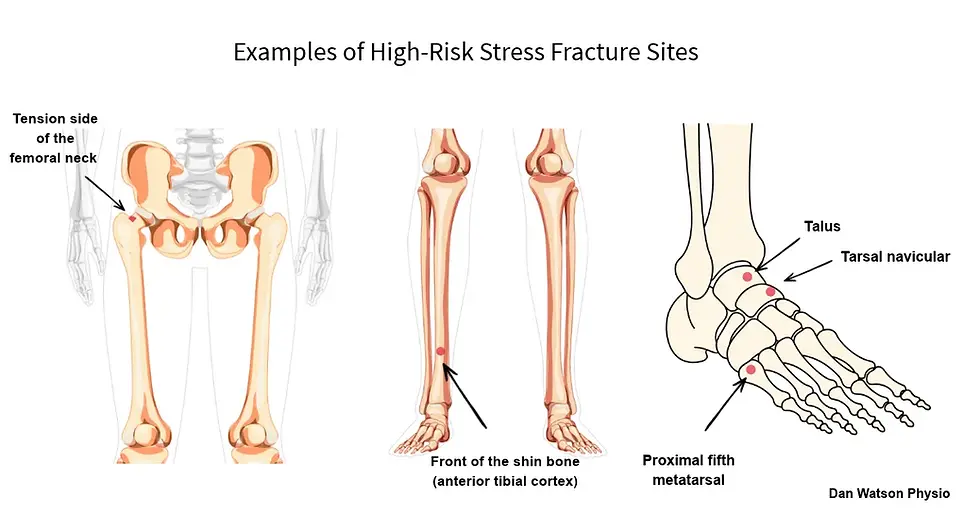
Certain stress fractures need more cautious assessment and management because they have a higher risk of healing problems or worsening injury. Examples include the tension side of the femoral neck at the hip, the front of the shin bone, and certain bones in the ankle and foot. Management also depends on severity, symptoms and imaging findings.
Do I need an X-ray or MRI?
Early X-rays can be normal, particularly in the first stages of a bone stress injury. This does not necessarily mean there is no injury.
If a stress fracture is suspected, a clinician may recommend:
A detailed history and physical examination.
Temporary modification of aggravating activity.
An X-ray in some cases.
An MRI if suspicion remains high, symptoms are significant, or the suspected site is high-risk.
MRI is often useful because it can identify bone stress earlier and show the extent of the injury more clearly than an early X-ray. Imaging decisions should be made with a clinician, particularly where a high-risk site is suspected.
How are stress fractures treated?
Treatment aims to reduce pain, allow the bone to recover, address factors that contributed to the injury, and restore strength and confidence before returning to full activity.
Depending on the site and severity, this may include:
Reducing or temporarily stopping the activity causing pain.
Modifying walking or weight-bearing if symptoms require it.
Using crutches or a protective boot only where clinically appropriate.
Maintaining fitness and strength through non-painful exercise, such as swimming, cycling or guided rehabilitation.
Progressing strength, balance and movement control.
Reviewing nutrition, energy availability, sleep and training history.
Referral for imaging or specialist opinion where indicated.
The aim is not simply to rest until pain disappears. Once symptoms settle, rehabilitation should rebuild the capacity needed for walking, running, jumping or sport.
Returning to running or sport
Return to activity should be gradual and guided by symptoms, function and the specific injury site. A typical progression may move from pain-free walking, to strength and balance work, to fast walking or low-level impact, then to short intervals of running before gradually rebuilding distance and intensity.
In my experience supporting athletes after stress fractures, the challenge is often bridging the gap between feeling comfortable in everyday life and tolerating repeated running, jumping or sport-specific loading. Rehabilitation needs to prepare for those demands, not just the first pain-free session.
Useful progress markers include:
Walking without pain or limping.
Tolerating single-leg strength and balance exercises.
Completing clinician-guided hopping or impact exercises without pain at the injury site during or afterwards, once appropriate for your injury.
Following an individualised return-to-running programme, with progression guided by symptoms and your clinician’s advice.
These are rehabilitation milestones, not tests to try yourself when a stress fracture is suspected.
Rehabilitation should also address the reasons the injury developed. For runners, this may include rebuilding single-leg strength and control, reviewing training load, and gradually reintroducing impact. You may find these guides useful:
When to seek assessment
Seek prompt assessment if you have:
Localised bone pain that worsens with activity.
Pain when walking, at rest or at night.
Pain that is not settling after reducing training.
Difficulty bearing weight or a noticeable limp.
Persistent hip, groin, foot or back pain associated with training, particularly if it affects walking or is worsening.
A history of repeated stress fractures or concerns around nutrition, energy availability or hormonal health.
A stress fracture should not usually be managed by simply pushing through pain. If you are unsure, a physiotherapy assessment can help decide whether your symptoms need monitoring, imaging, activity modification or onward referral.
If pain is stopping you from running, training or enjoying your usual activities, you can book a physiotherapy assessment in Colchester or explore online physiotherapy.
Frequently asked questions
Can I walk on a stress fracture?
Sometimes, but it depends on the site and severity. Some low-risk stress fractures can be managed with modified walking and activity, while others require reduced weight-bearing or further assessment. Pain when walking, limping or night pain should be assessed promptly.
How long does a stress fracture take to heal?
Recovery time varies considerably. Some low-risk bone stress injuries settle over several weeks with modified loading, while high-risk injuries may take longer and require a more protective approach. The right timeline depends on the location, severity, symptoms and rehabilitation progress.
Do stress fractures always show on an X-ray?
No. Early stress reactions and some stress fractures may not appear on initial X-rays. If suspicion remains high, an MRI may be recommended because it is more sensitive for detecting early bone stress injury.
Can physiotherapy help a stress fracture?
Yes. Physiotherapy can help identify contributing factors, guide safe activity modification, maintain strength and fitness where appropriate, and lead a structured return-to-running or return-to-sport programme.
When can I run after a stress fracture?
You can usually consider running again once you can walk comfortably, tolerate progressive strength and loading exercises, and your clinician is satisfied that the bone is healing appropriately. Returning too early, or increasing mileage too quickly, can increase the risk of symptoms returning.
Can a stress fracture heal without rest?
Some low-risk injuries may settle with a meaningful reduction in the aggravating activity rather than complete rest. However, continuing to train through worsening pain is risky, particularly with high-risk sites. Assessment is important if symptoms persist or progress.
References and Further Reading
Mountjoy M, et al. 2023 International Olympic Committee’s consensus statement on Relative Energy Deficiency in Sport (REDs). British Journal of Sports Medicine. 2023;57(17):1073–1097. 2023 International Olympic Committee’s (IOC) consensus statement on Relative Energy Deficiency in Sport (REDs) | British Journal of Sports Medicine
StatPearls. Stress Fractures. National Center for Biotechnology Information. Updated 2023. https://www.ncbi.nlm.nih.gov/books/NBK554538/
Miller TL, Kaeding CC. Management of Bone Stress Injuries: A Holistic Approach. Clinics in Sports Medicine. 2026;45(3):567–582. doi:10.1016/j.csm.2025.10.005. Available at: https://www.em-consulte.com/article/1779731/management-of-bone-stress-injuries-a-holistic-appr
Relative Energy Deficiency in Sport and Eating Disorders. National Eating Disorders Association. https://www.nationaleatingdisorders.org/relative-energy-deficiency-in-sport-red-s/
Miller TL, Best TM. Taking a holistic approach to managing difficult stress fractures. Journal of Orthopaedic Surgery and Research. 2016;11(1):98. doi:10.1186/s13018-016-0431-9. Available at: https://pmc.ncbi.nlm.nih.gov/articles/PMC5016928/
About the Author

Dan Watson is a Chartered Physiotherapist based in Colchester, Essex, specialising in the assessment and treatment of pain, injury and movement-related problems.
With over 15 years’ experience, Dan has supported everyday patients and athletes across football, rugby and The Royal Ballet. His approach combines clear assessment, practical education and progressive rehabilitation tailored to each person’s goals.
He provides face-to-face physiotherapy in Colchester, the wider Essex area, and online support for suitable patients across the UK. Read more about Dan’s background and credentials.


Comments